Mapping Intermedia
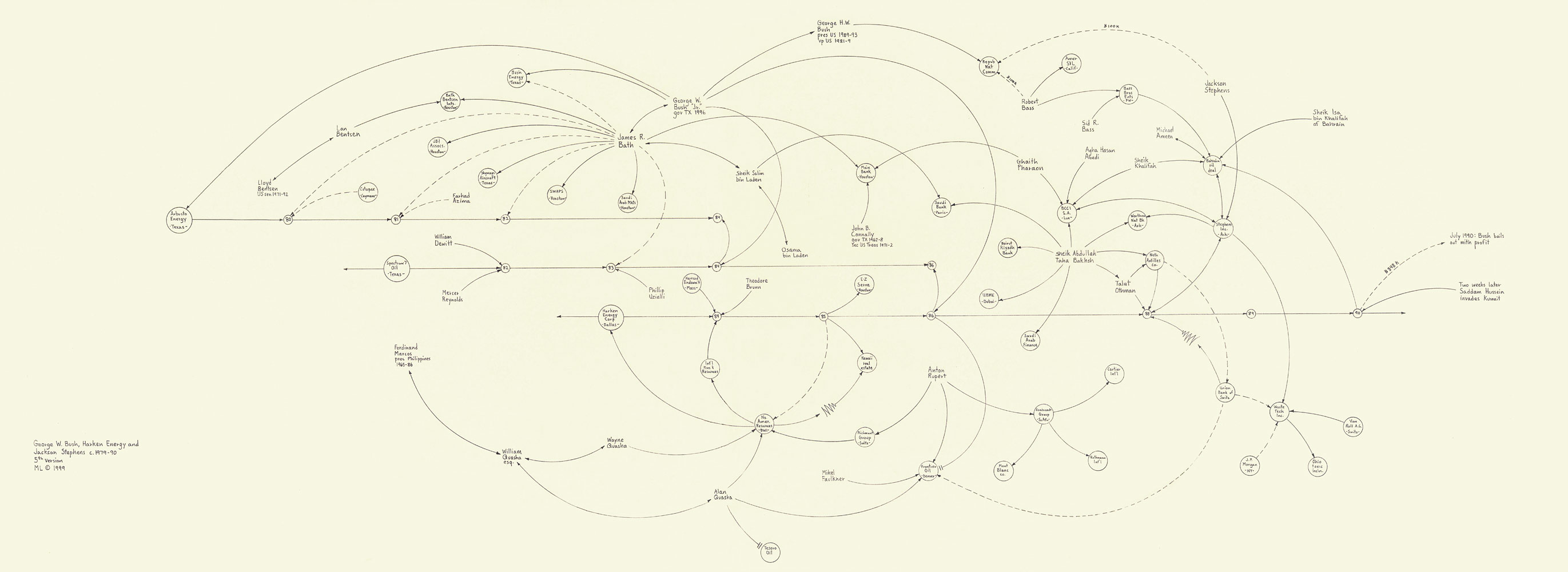
Mark Lombardi, George W. Bush, Harken Energy an Jackson Stephens c.1979-90 5th version (1999)
Overview
So what exactly is intermedia art? What distinguishes intermedia practice from multimedia, new media, digital, or computational practices? What critical concepts shape the discipline? Who are key intermedia artists and thinkers? What topics specific to intermedia interest you and why?
Over the semester, we will begin to answer these important questions by collectively mapping intermedia practice and its possibilities by looking at texts, online media, and pop culture references to learn about key intermedia art, artists, critical concepts, and thinkers. Building from concepts of mapping, hypertext, wikis, the commons, and digital gardens, we will explore the value of collaborative and open-source knowledge-forming practices, compiling our research into a glossary style wiki called the Map of Intermedia. Through in-class group activities and small wiki contribution assignments, we will define key concepts, compile essential references, and build links across related topics such as intermedia, audiovisual art, media culture, transformation, and gesture.
Assignment sets:
Assignment Breakdown
| Assignments (3) | Unit | Topics | Component Due Dates | (%) |
|---|---|---|---|---|
| Mapping Intermedia 1 | What is Intermedia? | Media Theory Intermedia, Multimedia, New Media Materiality of media Systems, ecological, and geological ways of thinking | Group Activity Sep 21 (in-class) Contribution Sep 25 (wiki) | 10 |
| Mapping Intermedia 2 | Audiovisual Transformation | Transformative action Thinking Hybrid Technofeminisms (cyborgs, glitch, algorithms) Metamorphosis Temporalities and tuning | Group Activity Oct 19 (in-class) Contribution Oct 23 (wiki) | 10 |
| Mapping Intermedia 3 | Gestural Interfaces | Gestural interfaces Interaction and immersion Poetics of making, relation, and gesture Performance and representation | Group Activity Nov 16 (in-class) Contribution Nov 20 (wiki) | 10 |
| TOTAL (%) : | 30.0 |
Group Activities (x3)
At the beginning of each unit, you will be assigned a set of readings from which you will learn about critical concepts of intermedia practice. At the start of class on each group activity date, you will gather in your groups to discuss the readings and create a summary of the assigned group text. At the end of the activity, each group will share their summaries with the class. Access What's in a reading summary? to see what you should be included.
2-3 readings per unit:
- 1-2 foundation texts (assigned to the entire class)
- +1 additional text introducing a critical approach to the unit theme (assigned per group)
Map of Intermedia Contributions (x3)
After the group activity, each member of your group will choose a different keyword from your reading to individually make a contribution to the map. You will research your keyword by drawing directly on the author's text, using the internet or library, and/or accessing the course Reading List to make 2 separate contributions to the map:
- A keyword definition
- A supporting example of your keyword
These should be individual posts with their own distinct pages!
Keyword Contribution Requirements
Create a definition for a keyword you learned about in your group reading. Include the following in your contribution:
- Definition - Provide a clear and concise definition specific to author's point of view and reflecting any additional research on the term that you did to understand the concept
- Details - Provide relevant details about the keyword (ie. Where did the term originate? Who are the key figures responsible for defining it? How does the topic connect to the map or current unit theme? Details might vary depending on the keyword, so it's up to you determine what is relevant)
- Media - Minimum of 1 supporting image, video, or sound content, complete with captions and link to the original source
- List of related topics - A relevant list of topics that relate to your keyword, connecting to other contributions on the map, or identifying new research areas yet to be explored
- Sources - A list of all references, provided in consistent format with basic information (name, title, date, hyperlink)
Supplementary Example Requirements
Find an example that supports your chosen keyword (ie. an artist, artwork, theorist, pop culture reference, any specific media or technologies, art techniques, and so on..). Include the following in your page:
- Overview - Provide a clear and concise summary of your supplementary topic
- Details - Provide relevant details about the topic (ie. a brief history, key figures who contributed to the topic, description of how the topic connects to your glossary item, and so on. Details will vary depending on the topic, so it's up to you determine what is relevant)
- Media - Add supporting media (images, videos, or sound) content with captions and links to it's original source if not your own content
- Related Topics - A relevant list of topics that relate to your subject, connecting to other contributions on the map, or identifying new research areas yet to be explored
- Sources - A list of all references, provided in consistent format with basic information (name, title, date, hyperlink)
Assessment Criteria (per assignment)
This assignment has both individual and group components and will therefore be assessed based on depth of engagement in group work and on your contributions made to the Map of Intermedia.
| Component | Criteria | Points |
|---|---|---|
| Group Activity | Present for group activity (1 pt) and actively contributed to the formation of the reading summary (1 pt) | 2 |
| -- | Clear and well articulated overview of the reading shared with the class (1 pt) | 1 |
| -- | Key supporting points were succinctly summarized (0.5 pts) | 0.5 |
| -- | Student demonstrated reflection on the reading by sharing an opinion or critical perspective (0.5 pts) | 0.5 |
| Map of Intermedia Contribution | 1 glossary item identifies a key term or critical concept from the group reading, fulfilling submission criteria: - Definition - Clear and concise (0.75 pts) - Details - Relevant details identified and concisely presented (0.75) - Media - Supporting media (image, video, or sound) present with captions and a reference link (0.5 pts) - List of related topics - Relevant; connects to other contributions/identifies new research areas (0.5 pts) - References - Consistent citation format including basic information (name, title, date, hyperlink) (0.5 pts) | 3 |
| -- | 1 supplementary topic identifies an example from the group reading, fulfilling submission criteria thoughtfully: - Definition - Clear and concise (0.75 pts) - Details - Relevant details identified and concisely presented (0.75) - Media - Supporting media (image, video, or sound) with captions and a reference link (0.5 pts) - List of related topics - Relevant; connects to other contributions/identifies new research areas (0.5 pts) - References - Consistent citation format including basic information (name, title, date, hyperlink) (0.5 pts) | 3 |
| TOTAL (pts) | 10.0 |
Suggested Reading
- Appleton, A Brief History & Ethos of the Digital Garden (2020)
- Blas et al, Chart of Transitions (2025)
- Hertz, A Definition of DIY (2023)
- Hess, Reconsidering the Rhizome (2008)
- How Wikipedia Changed the Way We Access Knowledge (2024)
- Moulthrop, Rhizome and Resistance (1994)
- Patel and Moore, A History of the World in Seven Cheap Things (2017)
- Wikipedia and the power of collective knowledge (2024)