Harris, excerpts from Composing Audiovisually (2021)
Excerpts on transperceptual attention, analysing audiovisual art, and hybrid creation
The analytical steps of encountering audiovisual work (pp. 64-65)
- Hear/look – Sentire (to sense) Begin by intuitively experiencing and sensing the work, on almost a passive level; without trying to think about the work, the media, what they are individually, what they are together, how they were made. Just experience, sense, hear and look.
- Listen/see – Audire (to hear, to review) Begin to think more critically and in detail about what you are seeing/ listening to and consider how to apply meaning. This might be specific/ intrinsic meaning, or might be more intuitive – how does the combination of sound and image construct meaning for you? Are there specific things the work is trying to say or speak to, or things it is attempting to address?
- Think/engage – Cogitare (to ponder, to think) Consider what you know about the work, the artist, the broader contexts, the way in which it might be described. What kind of work is this? Coda 65 How can this or does this contextual awareness shape how you experience the work?
- Understand/ref lect – Intelligere (to understand) Combine these layers of perceptual experience with contextual ones; bring them together, ask how they relate to one another and how they shape one another. How does (or simply does) this help to codify your experience of and response to the work? This should also be a recursive process, constantly open to reconsideration and reinterpretation, in light of new experiences, new ideas and changes in perspective. Much as with the listening modes described above, or the suggestions for ways to encounter visual work, this is in reality not necessarily a compartmentalised experience, but a f luid act of encountering which may be informed through some of these considerations.
The Layers of Engagement pp. 112-113
The Layers of Engagement discussed here will be broadly conceived as follows, with recognition that there will be considerable intersection between them:
- Experiential – concerned with how one experiences the work, including spatial factors, physical location, situation and technological mediation.
- Personal contextual – may be autoethnographic; concerned with any personal, perceptual, physiological or psychological contexts that have a bearing on the interpretation or reading of a work
- Critical contextual – concerned with the aesthetic, conceptual, theoretical, philosophical, phenomenological contexts surrounding the work
- Intentional – concerned with the compositional, aesthetic, conceptual, political, social, narrative or other specific intentions the artist had in developing the piece discussed.
The process for interrogating and analysing the works in this section will be as follows pp. 113-114
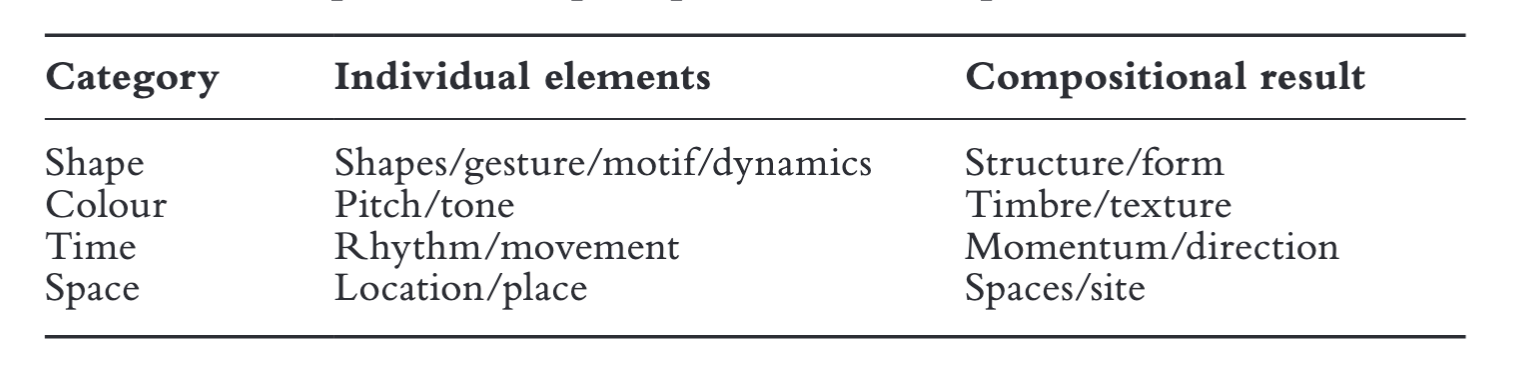
- 1: Hear/look – Sentire (to sense) Begin by intuitively experiencing and sensing the work, on almost a passive level, without trying to think about the work, the media, what they are individually, what they are together, how they were made. Just experience, sense, hear and look. This will facilitate the Initial, intuitive response section of each of the analyses below. 2: Listen/see – Audire (to hear, to review) Begin to think more critically and in detail about what you are seeing/listening to and consider how to apply meaning. This might be specific/intrinsic meaning, or might be more intuitive – how does the combination of sound and image construct meaning for you? Are there specific things the work is trying to say or speak to, or things it is attempting to address? Within this particular component of engaging with the work, we might begin to consider some of the elements of audiovisual composition suggested in Section 2 of this volume: Category Individual elements Compositional result Shape Shapes/gesture/motif/dynamics Structure/form Colour Pitch/tone Timbre/texture Time Rhythm/movement Momentum/direction Space Location/place Spaces/site 3: Think/engage – Cogitare (to ponder, to think) Consider what you know about the work, the artist, the broader contexts, the way in which it might be described. What kind of work is this? How can this or does this contextual awareness shape how you experience the work? 4: Understand/ref lect – Intelligere (to understand) Combine these layers of perceptual experience with contextual ones; bring them together, ask how they relate to one another and how they shape one another. How does (or simply does) this help to codify your experience of and response to the work? Steps three and four of this process will inform the Layers of Engagement with which each of the examples in this section is considered.
6 forms of audiovisual work pp. 114-115
Fixed-media audiovisual composition: A (usually) screen-based composition consisting of a fixed, temporal, audiovisual work, (usually) with single-channel video and stereo or multichannel audio. Audiovisual performance: A live performance work involving both sonic and visual components in combination. Audiovisual installation: An installation work, which may or may not be interactive, specifically assembled to address both sonic and visual sensory experience.Audiovisual sculpture: A three-dimensional audiovisual work in which the sonic and/or visual components are generated through the existence, enaction or interaction of/ with sculptural forms. Music video: A short film combining music with filmic imagery, often (but not always) produced for promotional or commercial purposes. Narrative form: Any form of screen-based narrative form such as narrative film, short film, television.
pp.197-99
-
- That composing audiovisually describes the act of creating with sound and visual materials in such a way as to consider them as being of equal importance in the conception, development, realisation and outcome of the work.
- That we can think about how to approach audiovisual composition through considering how elements of audiovisual composition are developed, both individually and together, and the results of combining these elements.
- That experiencing audiovisual works necessitates transperceptual attention and that, in turn, composing, thinking and analysing audiovisually are transperceptual acts.
Transperceptual attention is an apperceptive act in which I specifically attend to sight and sound and their interaction, and encounter other perceptual and contextual modes in light of that interaction.
- That we can begin to encounter audiovisual works using the following four steps/processes:
- Hear/look – Sentire (to sense) Begin by intuitively experiencing and sensing the work, on almost a passive level, without trying to think about the work, the media, what they are individually, what they are together, how they were made. Just experience, sense, hear and look.
- Listen/see – Audire (to hear, to review) Begin to think more critically and in detail about what you are seeing/listening to and consider how to apply meaning. This might be specific/intrinsic meaning, or might be more intuitive – how does the combination of sound and image construct meaning for you? Are there specific things the work is trying to say or speak to, or things it is attempting to address?Within this particular component of engaging with the work, we might begin to consider some of the elements of audiovisual composition suggested above.
- Think/engage – Cogitare (to ponder, to think) Consider what you know about the work, the artist, the broader contexts, the way in which it might be described. What kind of work is this? How can this or does this contextual awareness shape how you experience the work?
- Understand/ref lect – Intelligere (to understand) Combine these layers of perceptual experience with contextual ones; bring them together, ask how they relate to one another and how they shape one another. How does (or simply does) this help to codify your experience of and response to the work?This should also be a recursive process, constantly open to reconsideration and reinterpretation, in light of new experiences, new ideas and changes in perspective. Much as with the listening modes described above, or the suggestions for ways to encounter visual work, this is in reality not necessarily a compartmentalised process.
- That attempting to analyse and interrogate our encounters with audiovisual work should be both personal and situated.
- That individual, disciplinary perspectives can reveal useful things about a piece of work, but not everything.
- That it is possible to apply a transdisciplinary, transperceptual approach to audiovisual practices to encounter works from across a range of disciplinary and contextual backgrounds from a level footing.
- That this transdisciplinary, transperceptual approach marks the beginning of a potential discourse, but that much more needs to be done.